Azimuth Research | Research Paper | 2026
Bitcoin markets exhibit pronounced regime shifts that fundamentally alter volatility structures, return distributions, and aggregate market behavior. Identifying these latent states represents a critical challenge for institutional frameworks focused on dynamic exposure management. This research evaluates the conceptualization of market regimes within cryptocurrency markets and examines the robust statistical methodologies utilized for transition detection. Drawing from empirical literature, we analyze the integration of regime-switching signals into systematic allocation architectures. Understanding these dynamics allows for the adaptation of exposure to evolving structural environments, offering an alternative to traditional static allocation paradigms.
Financial time series rarely manifest as stationary systems; rather, they evolve through distinct phases defined by distinct volatility regimesand investor heuristics. These periods, or market regimes, are particularly evident in Bitcoin markets. Since its inception, the asset has transitioned through cycles of rapid expansion, speculative bubbles, and protracted contractions.
Identifying these structural inflections is paramount for the development of resilient portfolio frameworks capable of navigating the non-linear risk inherent in digital assets.
The study of market regimes is foundational in financial economics, addressing instances where a single statistical process fails to capture structural breaks in time series data. Hamilton (1989) codified this approach by introducing Markov regime-switching models to analyze macroeconomic cycles. Subsequent applications in asset pricing and volatility modeling have demonstrated that accounting for regime-dependent parameters significantly improves the explanatory power of econometric models compared to constant-parameter alternatives.
Empirical evidence strongly suggests that Bitcoin markets operate under strong regime dependency. Research utilizing switching models indicates that volatility and return dynamics undergo significant shifts across different market states. Specifically, literature often identifies a dichotomy between low-volatility expansionary regimes and high-volatility stress environments, separated by brief transitional phases. These shifts necessitate a move away from fixed exposure strategies, as the underlying risk-reward ratio is conditional upon the prevailing regime.
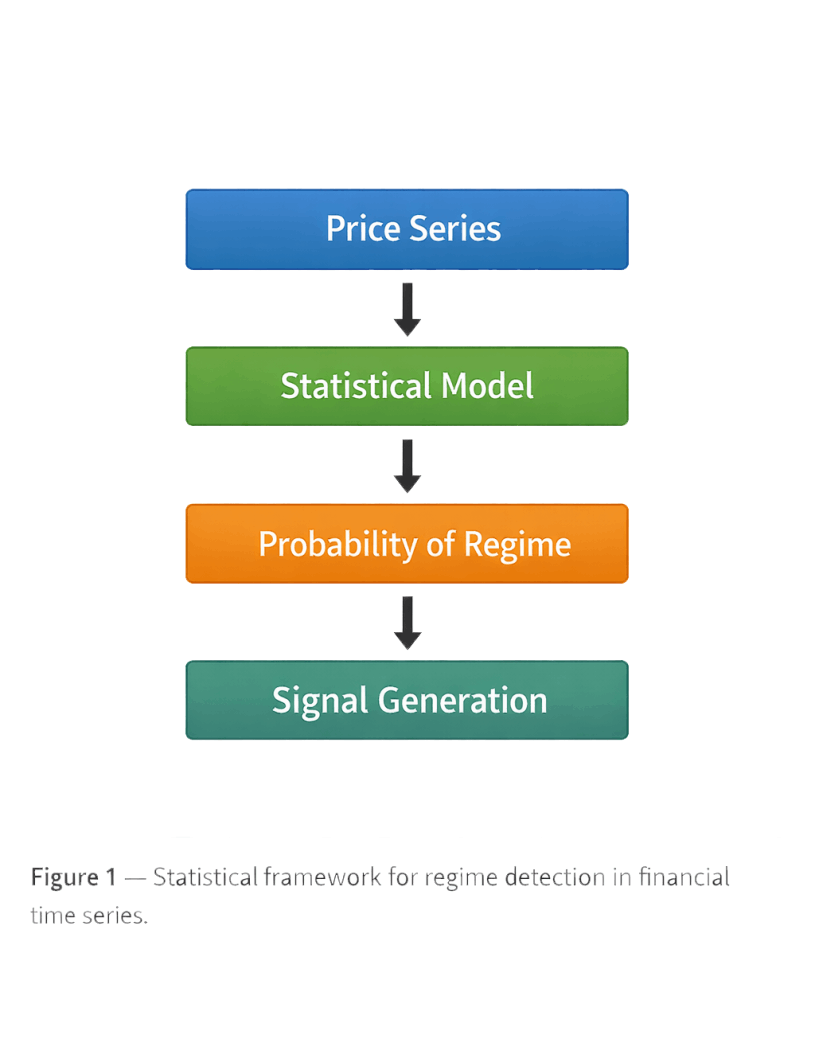
Multiple quantitative approaches facilitate the identification of these transitions. Markov regime-switching models remain prevalent due to their ability to treat regime transitions as a stochastic process governed by a transition matrix.
Alternative methodologies include Hidden Markov Models (HMM), GARCH-based volatility regime models, and structural break tests. Recent implementations in the cryptocurrency space confirm that Bitcoin’s volatility is not merely persistent but strictly regime-dependent, requiring models that can adapt to rapid changes in market variance.
The integration of regime detection into systematic allocation is essential for maintaining portfolio stability. If market properties diverge significantly across states, static exposure inevitably leads to sub-optimal risk outcomes. High-volatility regimes are frequently correlated with elevated downside risk and fat-tailed distributions; conversely, expansionary regimes favor increased capital allocation. Dynamic frameworks utilize these quantitative signals to calibrate position sizing in alignment with the latent market structure.
Deploying regime-switching models in live investment strategies involves significant technical hurdles. Primarily, regime identification is probabilistic; models yield a likelihood of being in a state rather than a deterministic certainty. Furthermore, markets may exhibit sudden transitions that lag behind statistical detection, and models are susceptible to overfitting if not validated via rigorous out-of-sample testing. Consequently, these models are typically utilized as core components of broader multi-factor risk architectures.
Systematic frameworks incorporating regime detection prioritize objective adaptation over discretionary market timing. By utilizing quantitative signals to identify structural shifts, these strategies can adjust exposure constraints and volatility controls in real-time. This methodological rigor helps mitigate the impact of extreme market stress while preserving participation during favorable structural phases, ultimately enhancing the consistency of risk-adjusted returns.
Bitcoin markets provide clear evidence of regime-dependent behavior that challenges traditional investment assumptions. For the disciplined investor, the ability to identify and respond to these structural shifts is vital for long-term capital preservation. Quantitative regime detection frameworks offer a sophisticated mechanism for navigating the inherent volatility of digital assets, ensuring that portfolio exposure remains calibrated to the prevailing market environment.
• Hamilton, J. (1989). A new approach to the economic analysis of nonstationary time series and the business cycle. Econometrica.
• Ardia, D., et al. (2019). Regime changes in Bitcoin GARCH volatility dynamics. Finance Research Letters.
• Caporale, G. M., et al. (2018). Modelling volatility of cryptocurrencies using regime-switching models.
• Baur, D., et al. (2018). Bitcoin, gold and the US dollar. Journal of International Financial Markets.