Risk Management in High-Volatility Assets

Systematic frameworks for exposure control and portfolio resilience.

Azimuth Research | Research Paper | 2026

Abstract

Managing assets characterized by extreme price dispersion—specifically digital assets like Bitcoin—requires risk management frameworks that extend beyond traditional equity models. This research examines why these assets exhibit "fat-tail" distributions and persistent volatility clustering. By integrating volatility budgeting with regime-aware allocation, it is possible to construct a portfolio capable of navigating structural market uncertainty. The primary objective is not the total elimination of risk, but the systematic management of exposure across different market states.

1. Introduction 

The rise of Bitcoin as a global financial asset has been defined by a return profile that is significantly more volatile than traditional markets. Unlike standard asset classes, the distribution of returns in this space is marked by abrupt price swings and significant tail risk. Furthermore, these characteristics present a substantial challenge for investors seeking to maintain long-term exposure without suffering catastrophic drawdowns.

Most risk frameworks were developed for stable equity environments and often assume that volatility remains within a constant range. In the cryptocurrency sector, these assumptions are frequently violated. Consequently, there is a clear need for risk control mechanisms that are as dynamic as the underlying market signals.


2. Volatility Characteristics in Digital Assets  

Empirical data suggests that Bitcoin's volatility levels are several times higher than those of major stock indices. A key feature is "volatility clustering," where periods of high instability tend to persist over time.

Applying GARCH modeling indicates that these shocks do not dissipate rapidly; instead, they propagate through the system. This results in a return distribution where extreme movements occur with much higher frequency than predicted by a standard normal curve. For a systematic investor, ignoring this persistence can lead to significant miscalculations in risk exposure.


3. Drawdowns and the Necessity of Systematic Control   


The history of Bitcoin is characterized by a series of severe market contractions, including the bear markets of 2014-2015 and the deleveraging event of 2022. These drawdowns represent a critical threat to capital preservation.

If an investor maintains a static position, they must be prepared to endure losses exceeding 80%. For most institutional portfolios, such exposure is unacceptable. This necessitates the implementation of dynamic exposure controls to ensure long-term survivability.


Mobirise Website Builder

4. Volatility Targeting and Risk Budgeting

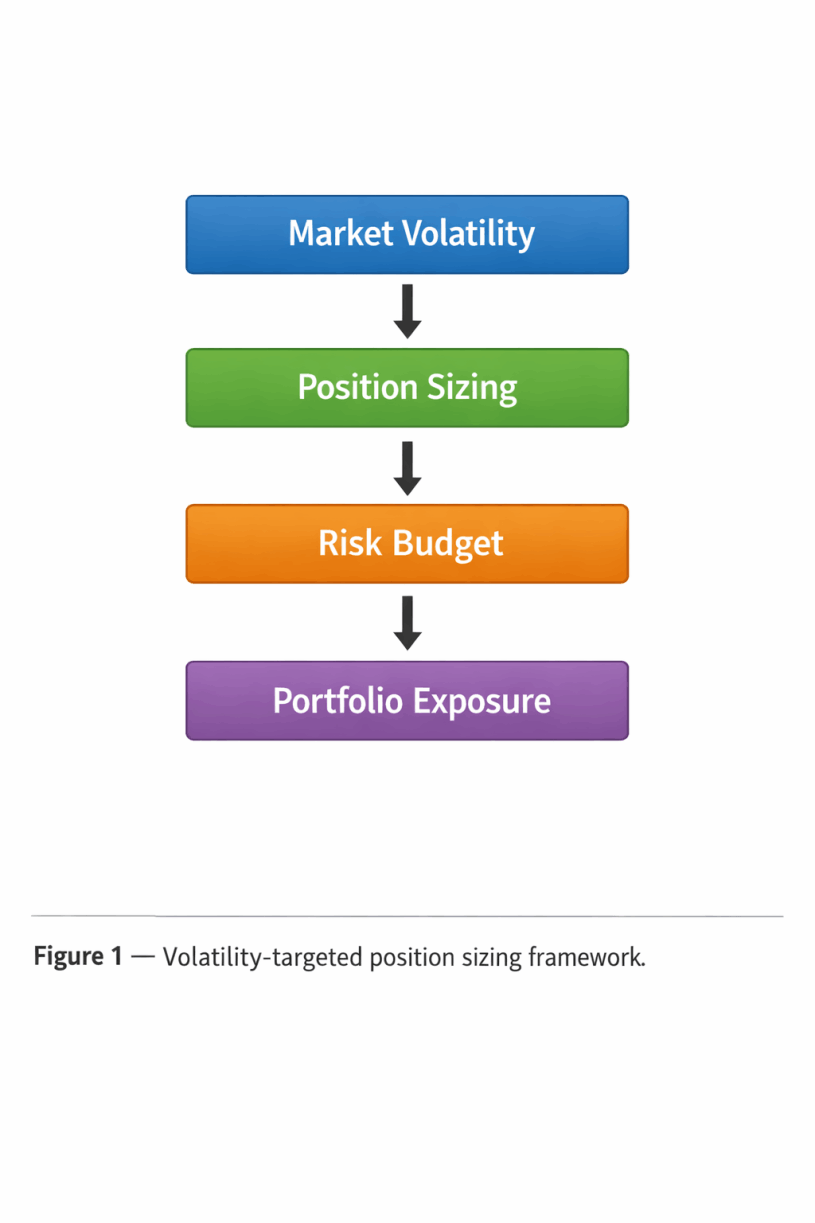
An effective methodology for managing this risk involves volatility-adjusted position sizing. Instead of maintaining a fixed allocation, the position size is scaled according to current market movement.

This approach, known as volatility targeting, helps stabilize the return profile. The logic is consistent: when volatility spikes, exposure is reduced to protect the capital base. In addition, when the market stabilizes, the position can be expanded. This ensures the total risk of the portfolio remains within a predefined budget.
5. Market Regime Detection       


Financial markets often alternate between distinct "regimes," ranging from steady growth phases to high-stress contractions. Markov-switching models are effective for identifying these shifts in market state. By adjusting exposure based on the current regime, investors can mitigate the impact of bear markets while participating in expansionary phases.


Mobirise Website Builder

6. Multi-Layered Signal Frameworks

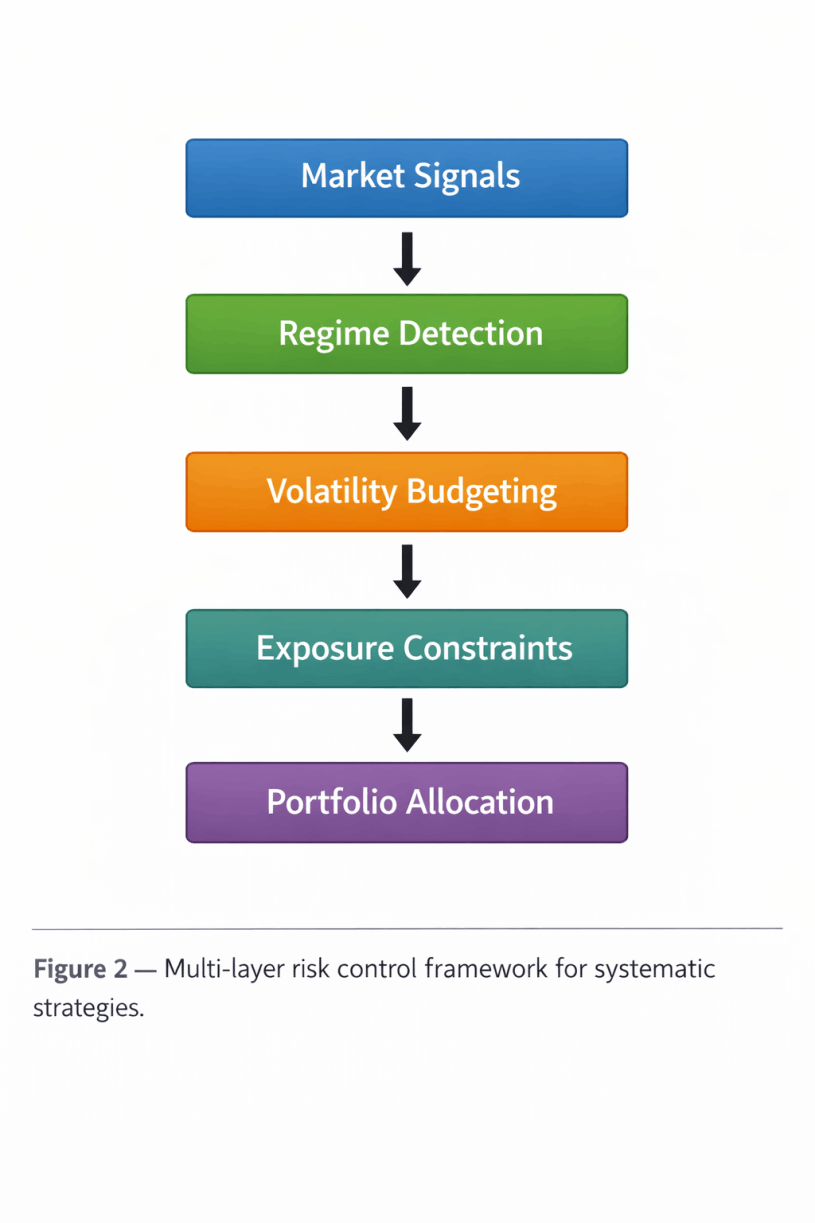
Robust systematic strategies often utilize multiple layers of protection to manage signals:

Volatility Budgeting: Establishing a maximum threshold for risk.

Regime Detection: Identifying the underlying market environment.

Exposure Constraints: Implementing automated brakes to cut risk during extreme events.

7. Implications for Portfolio Construction        


When allocating capital to highly volatile assets, traditional "buy-and-hold" strategies may prove insufficient due to short-term variance. Dynamic frameworks provide a method for adapting to market evolution, seeking a balance between stability and growth potential.


Conclusion      


In conclusion, Bitcoin presents unique opportunities alongside significant structural risk. However, by utilizing quantitative frameworks—such as volatility controls and regime-aware modeling—investors can manage that risk systematically. The focus remains on managing the exposure rather than predicting price direction.


References      


• Katsiampa, P. (2017). Volatility estimation for Bitcoin.
• Moreira, A., & Muir, T. (2017). Volatility-managed portfolios.
• Baur, D., et al. (2018). Bitcoin: Speculative asset or medium of exchange.
• Dyhrberg, A. (2016). Bitcoin, gold and the dollar: A GARCH volatility analysis.
Finance Research Letters.