Azimuth Tactical Strategy
Systematic multi-asset spot strategy for serious investors: fully funded, rule-based, diversified across roles, and operated manually through private Telegram alerts with clear implementation instructions.
Backtest period 2013-01-02 → 2026-08-31. disciplined implementation operational results are shown for investor evaluation and should be read together with the full risk disclosure.
A disciplined multi-asset strategy built through extensive research.
Azimuth Tactical Strategy uses a proprietary systematic process to manage a diversified, fully funded portfolio. The public description focuses on investment objectives, risk characteristics and implementation discipline; the internal portfolio construction logic remains confidential.
The strategy was developed through extensive historical testing, practical operating checks and ongoing internal evaluation. The goal is to offer serious investors a structured allocation process instead of ad-hoc discretionary decisions.
Investors who want discipline, structure and a serious process.
The strategy is intended for investors able to follow consolidated allocation alerts, maintain broker discipline, tolerate drawdowns and evaluate the strategy over a medium-to-long-term horizon.
It is not a high-frequency trading system, not a leveraged product and not a discretionary stock-picking service.
Adaptive portfolio construction
Adaptive participation
Seeks long-term participation through a proprietary systematic allocation process.
Risk management
Seeks to reduce portfolio fragility during difficult market environments through proprietary risk controls.
Quality/resilience
Maintains stabilizing exposure designed to avoid a purely binary risk-on/risk-off profile.
Diversification
Allocates among broad diversification roles as conditions evolve.
Subscribers receive target-allocation instructions in a practical format. The public page focuses on the investment process, investor suitability and risk profile.
Why not just hold a passive diversified portfolio?
Passive diversified portfolios can still experience concentration, correlation spikes and prolonged drawdowns. Tactical is intended to provide a systematic alternative with an explicitly risk-aware portfolio process.
Azimuth Tactical Strategy uses a proprietary allocation framework. Production portfolio-construction and decision logic are not disclosed publicly.
The objective is not simply to be diversified, but to allocate more intelligently across changing market conditions: participate when opportunities are favorable, reduce aggressive exposure when risk expands and maintain a disciplined process without leverage, short positions or constant trading.
For long-term investors, this offers a more active and risk-aware alternative to a static portfolio.
Rules, constraints and risk controls.
The strategy evaluates finalized market data through a proprietary decision framework and issues a consolidated portfolio target only when the model requires a meaningful change.
- Rules-based portfolio construction with documented governance.
- Event-driven tactical adjustments when predefined conditions are met.
- Risk controls are embedded in the private production framework.
- Diversification is evaluated across multiple market environments.
- Cost-aware simulation and operationally simple target-weight instructions.
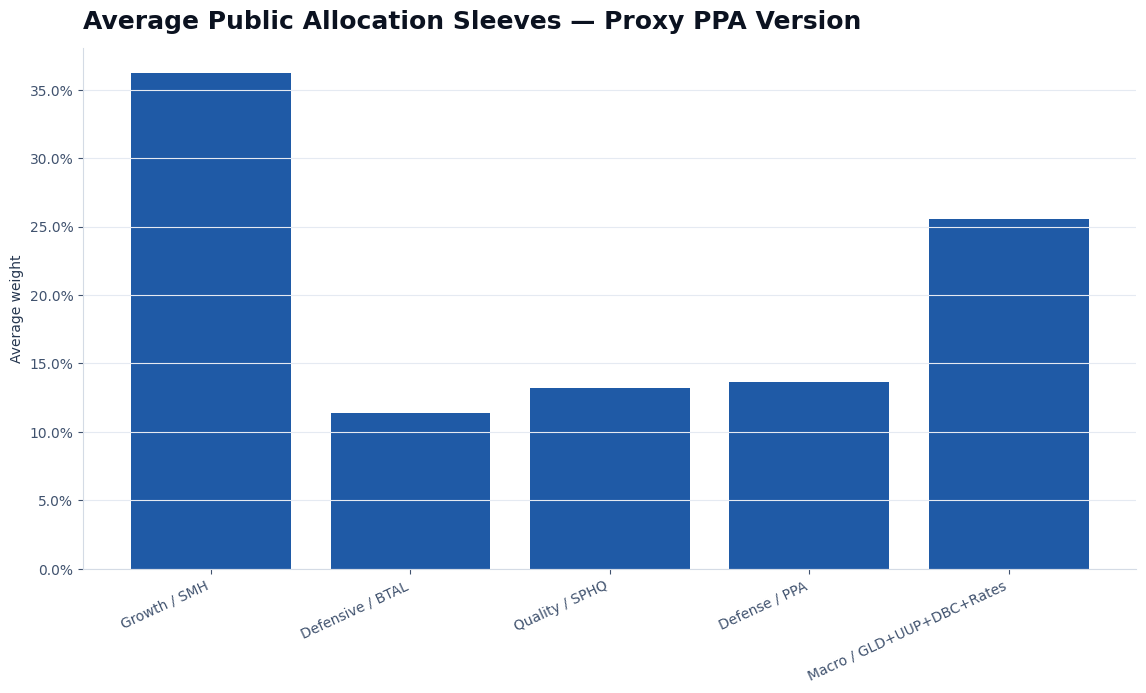
From systematic review to disciplined implementation.
Model check
The production model evaluates finalized market data and portfolio state through proprietary rules that are not disclosed publicly.
Alert event
If an action is required, a private Telegram alert identifies the event and consolidated target allocation.
Execution instructions
The subscriber receives clear instructions to translate the target allocation into broker-level orders.
Audit trail
Signals, dates, weights and execution assumptions are internally tracked for review and coherence checks.
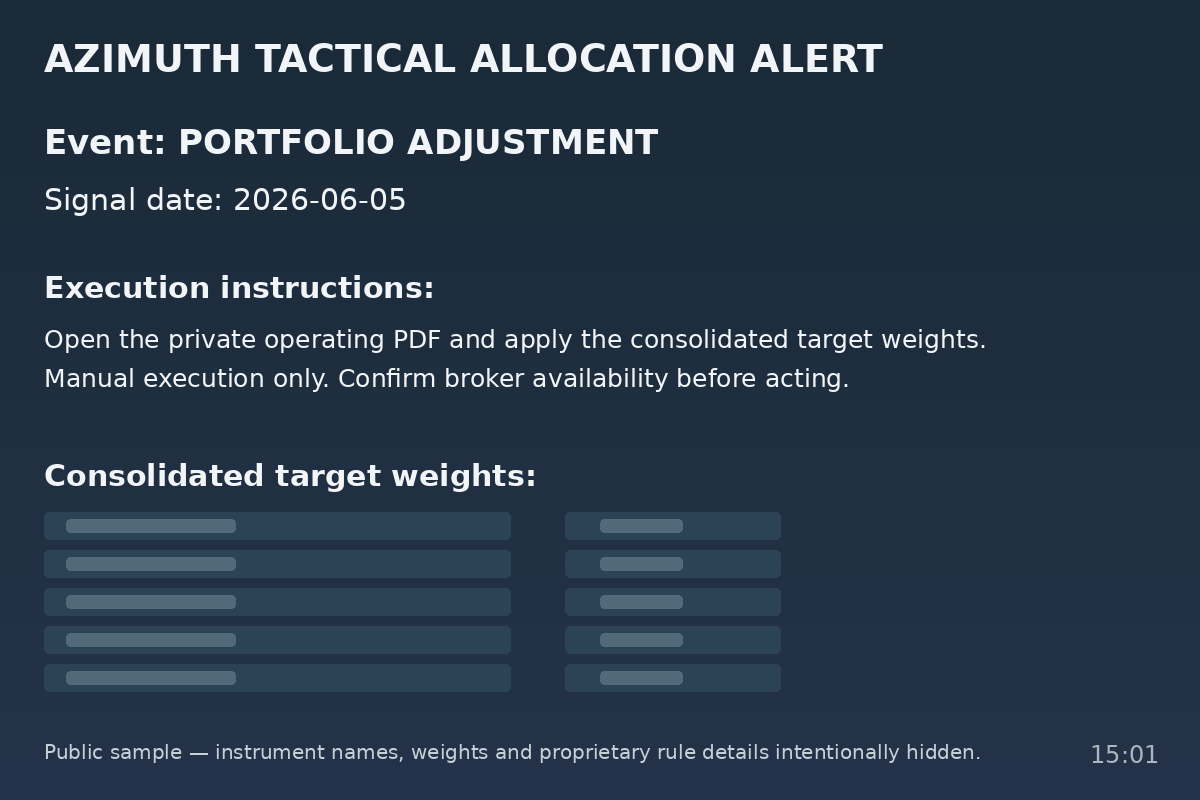
Clear alerts, disciplined execution.
Alerts are designed to be simple, actionable and easy to follow: strategy name, event type, signal date, execution instruction and consolidated target allocation.
Tactical Strategy does not offer copy trading. Its multi-instrument, target-allocation nature is not well suited to standard copy-trading platform formats, so it is offered as a manual alert service for disciplined investors.
Execution is intended only for brokers where all required instruments are available and where dividend/distribution reinvestment can be enabled when available.
Performance, risk and robustness are evaluated together.
Results are simulated net results generated by the audited production framework using validated historical data and the same public methodology described in the factsheet.
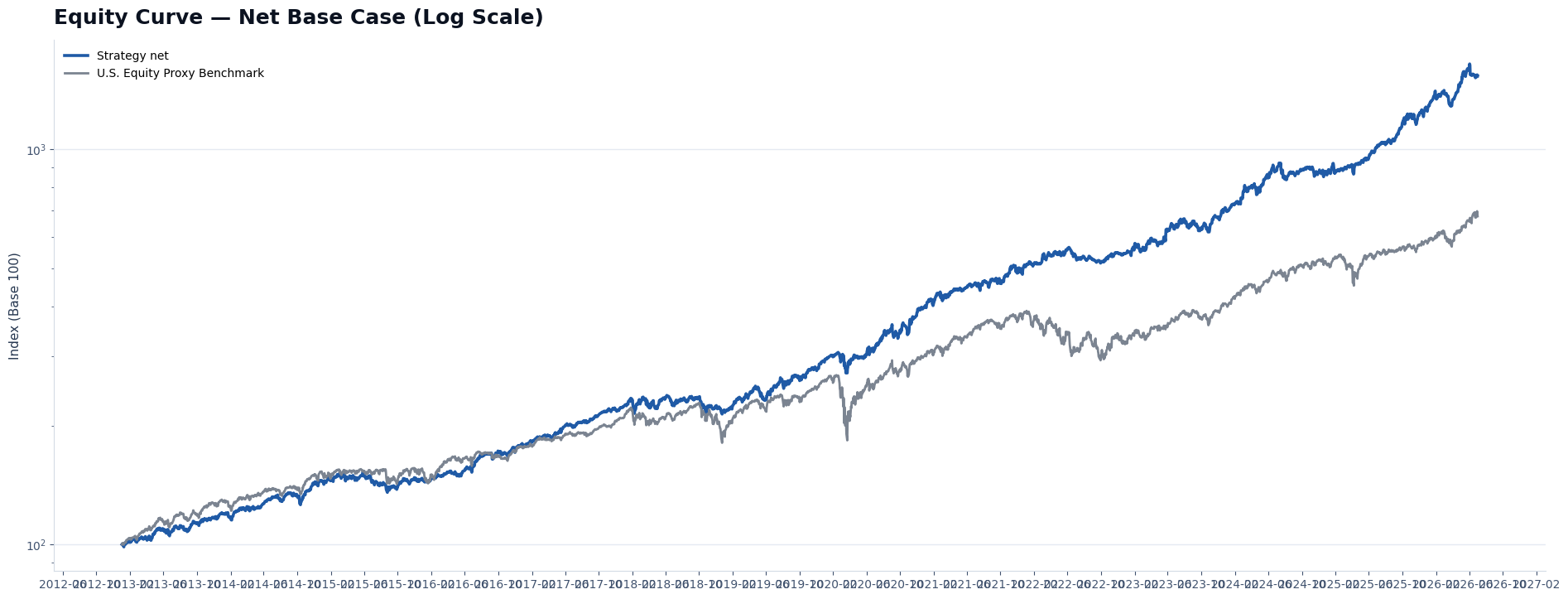
Designed to compete through smoother compounding.
The public simulation compares the strategy against a U.S. Equity Benchmark for context. The goal is not to mimic the benchmark, but to improve the balance between return, drawdown and recovery behavior.
| Metric | Strategy | U.S. equity reference |
|---|---|---|
| CAGR | 23.65% | 14.83% |
| Max drawdown | -10.09% | -33.72% |
| Volatility | 12.83% | 16.77% |
| CAGR / Vol | 1.84 | 0.88 |
Risk is monitored as a first-class metric.
The strategy is evaluated through maximum drawdown, recovery time, ulcer index, tail behavior, rolling performance and cost sensitivity. The intention is to avoid a portfolio that looks attractive only because of a narrow historical window.
Strong uninterrupted bull markets may cause the strategy to underperform a fully exposed benchmark. That trade-off is part of the design: the strategy prioritizes smoother participation over maximum beta.
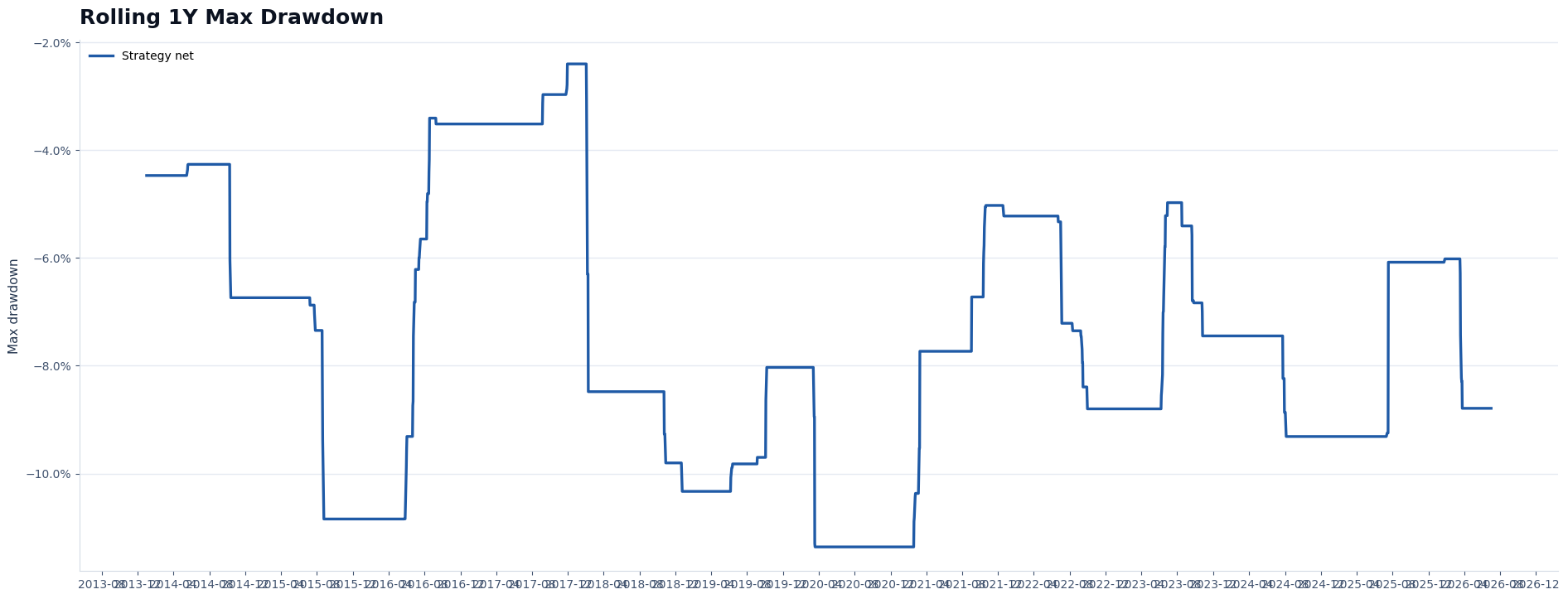
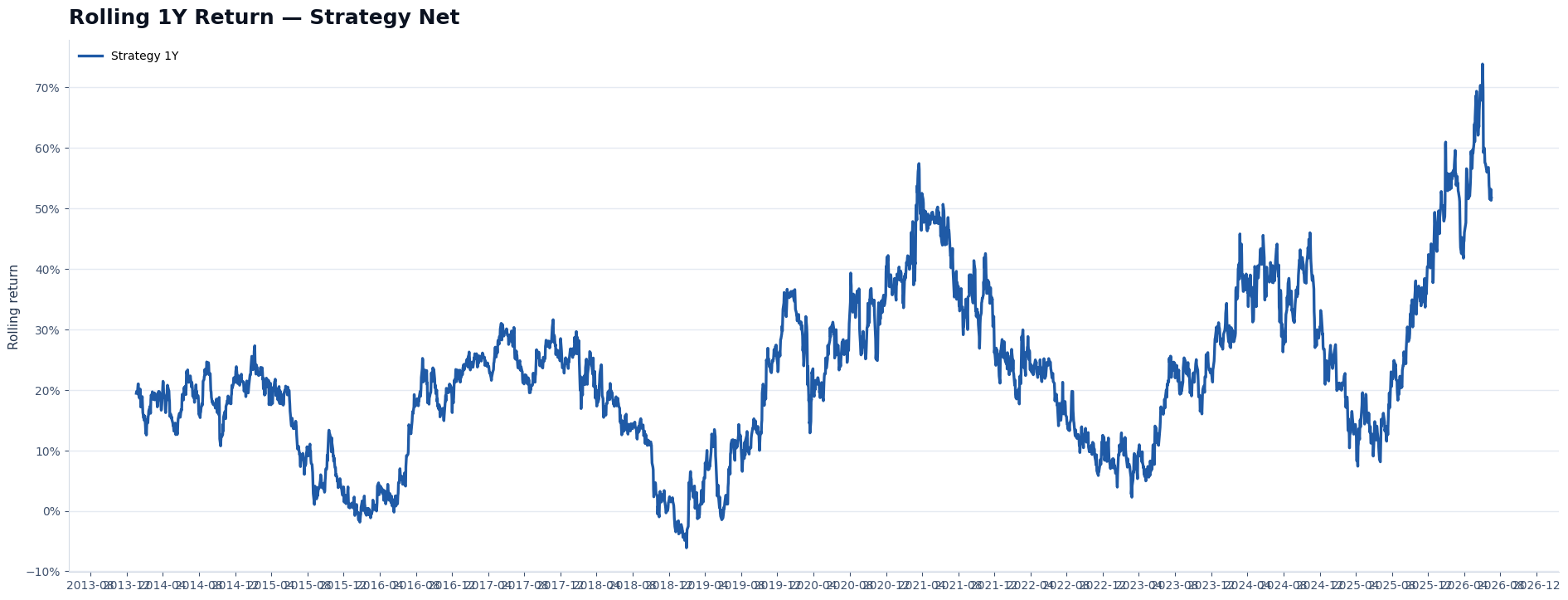
Not just one good backtest.
Rolling windows are used to detect performance concentration, regime dependence and degradation. Monte Carlo block bootstrap is used as an additional robustness check. In the public run, median MC CAGR is 23.59%, with a 5th percentile of 17.83% and a 95th percentile of 29.45%.
The model can be internally audited and reviewed periodically. Parameters are not changed automatically just because time passed; candidate changes must pass robustness and operational-coherence gates.
Manual, broker-aware and operationally disciplined.
Manual alert service
Tactical Strategy is not offered as copy trading because its multi-instrument, target-allocation nature is not well suited to standard copy-trading platform formats. Subscribers receive manual alerts and clear implementation instructions.
Eligible brokers only
The strategy should be used only where all required instruments can be traded correctly and position sizes can be implemented with adequate precision.
Dividend/distribution handling
Automatic reinvestment of dividends or distributions is recommended where available, so implementation remains aligned with the fully funded total-return intent.
Internal review and optimization discipline.
Ongoing monitoring
Rolling returns, drawdowns, volatility and implementation quality are monitored to detect degradation.
Periodic research review
The strategy may be internally reviewed and optimized from time to time through a formal process that prioritizes robustness, practical implementation and long-term consistency.
Change gates
Candidate updates must improve risk-adjusted behavior, avoid overfitting and remain coherent under implementation stress and alternative historical environments.
For investors seeking a systematic allocation process.
Azimuth Tactical Strategy is designed for investors who prefer rule-based portfolio management, intelligent allocation rules, ongoing evaluation and disciplined signal execution over ad-hoc discretionary decisions.
Past performance, simulated performance and backtests do not guarantee future results. Investors can lose money.