Adaptive multi-asset allocation

Azimuth Dynamic Strategy

A fully funded systematic strategy driven by a proprietary multi-asset allocation framework. Public materials disclose objectives, historical behavior, risk and validation evidence while keeping portfolio construction and decision logic confidential.

Fully fundedLong-onlyManual allocation alertsNo copy trading
33.19%Net CAGR
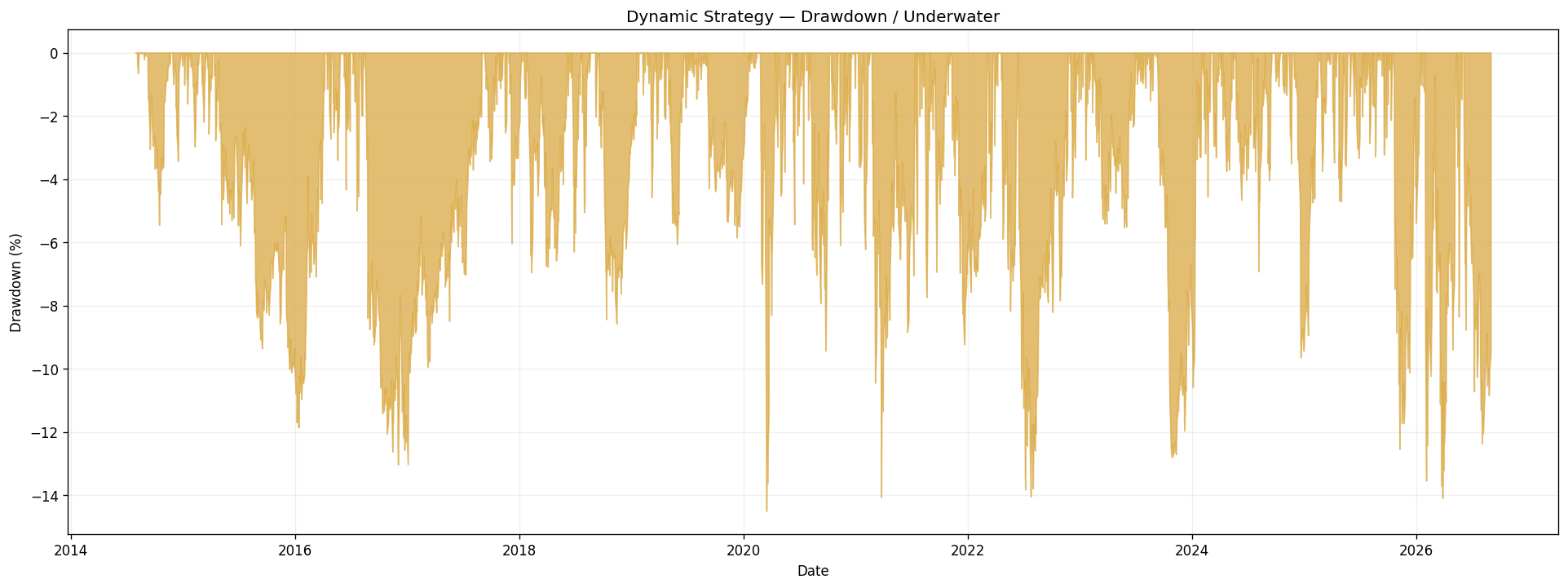
-14.50%Maximum drawdown
2.29Calmar ratio
31.59×Final multiple
Public overview

A systematic strategy presented at the investor level.

Dynamic is a proprietary, fully funded quantitative strategy designed for long-term capital growth with disciplined risk management. Public materials focus on outcomes, validation and implementation rather than production logic.
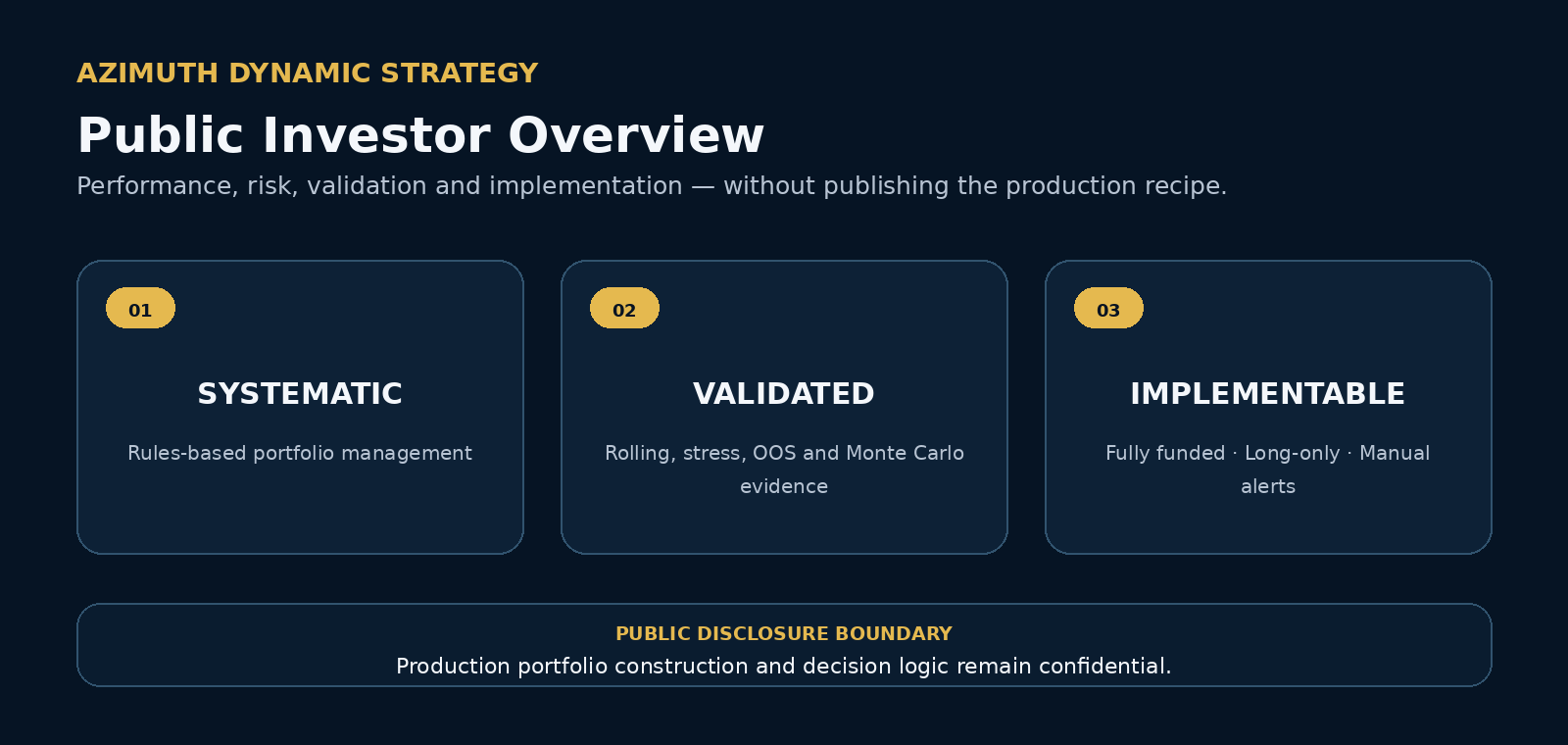
Azimuth Dynamic public investor overview

Systematic

Rules-based portfolio management under a documented production process.

Validated

Historical, rolling, stress, out-of-sample and Monte Carlo evidence.

Implementable

Fully funded, long-only implementation through private manual allocation alerts.
Investor information

What is public, and what remains proprietary.

Performance evidence

Full-history and rolling results are presented with consistent methodology and stated assumptions.

Risk evidence

Drawdowns, tail diagnostics and stress results describe the historical risk profile.

Robustness

Out-of-sample, perturbation and Monte Carlo studies test whether results depend on a narrow historical path.

Implementation

The mandate is fully funded and long-only, with current portfolio instructions delivered privately to approved subscribers.

Governance

Published evidence is tied to a frozen strategy reference and documented audit process.

Confidentiality

Production portfolio construction and decision logic remain private.

Historical results

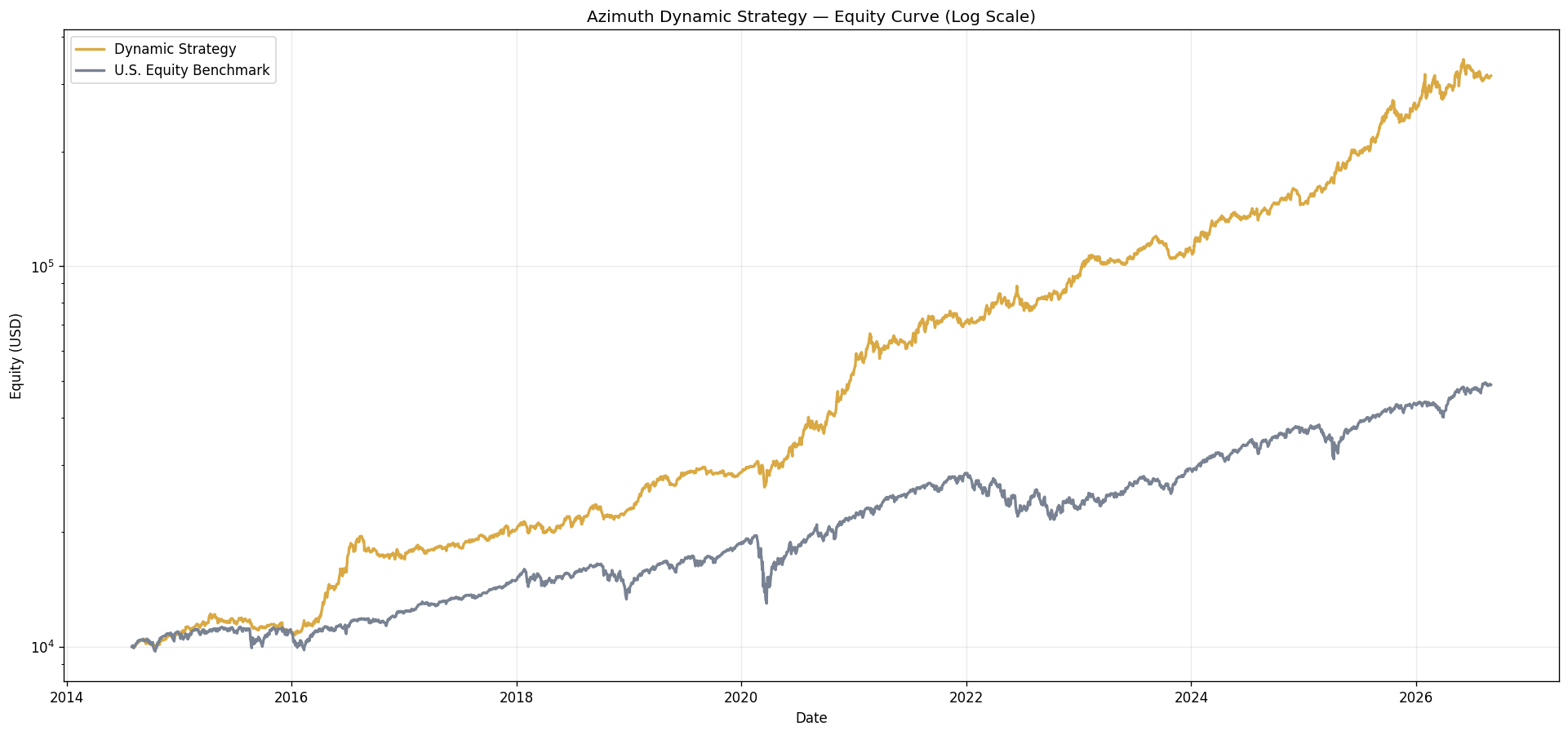
Full evaluation from August 2014 through August 2026.

The published figures and charts use the complete validated historical period. Results include modeled turnover costs and are simulated, not guaranteed.

Azimuth Dynamic versus U.S. Equity Benchmark, log scale

Full-history strategy growth compared with the same U.S. Equity Benchmark used for Tactical Allocation.

Azimuth Dynamic and U.S. Equity Benchmark drawdown comparison

Strategy and benchmark drawdowns shown together; the headline maximum drawdown uses the audited daily engine.

18.35%Annual volatility
-3.39%Worst rolling 1Y
13.99%Worst rolling 3Y annualized
265Maximum days below high-water mark
Robustness

Results were challenged across parameters, start dates, costs and unseen periods.

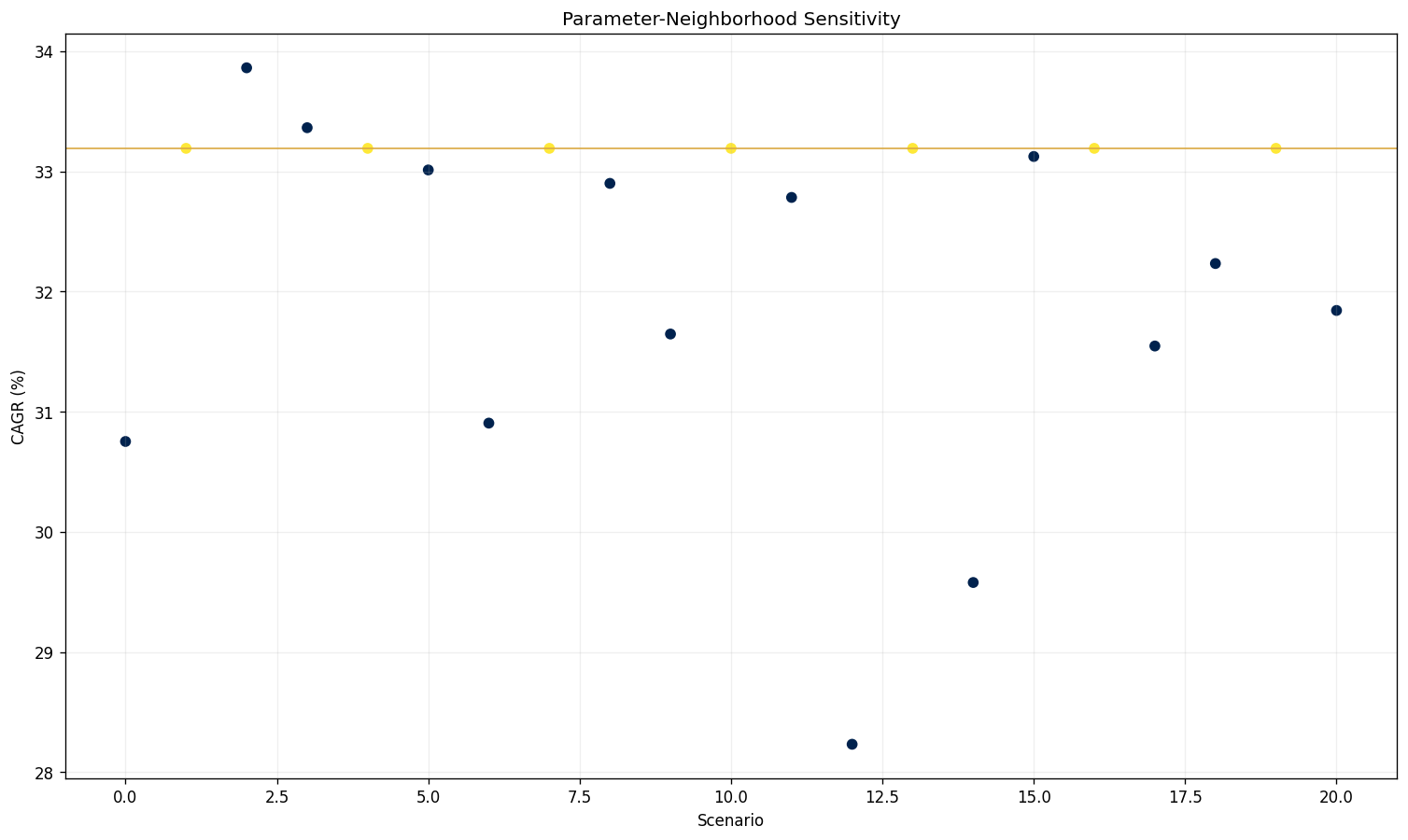
Parameter neighborhoods

Across 21 nearby-parameter scenarios, median CAGR was 33.01%, the 10th-percentile CAGR was 30.75%, and every tested scenario remained profitable; the weakest CAGR was 28.23%.

Dynamic parameter sensitivity scatter plot

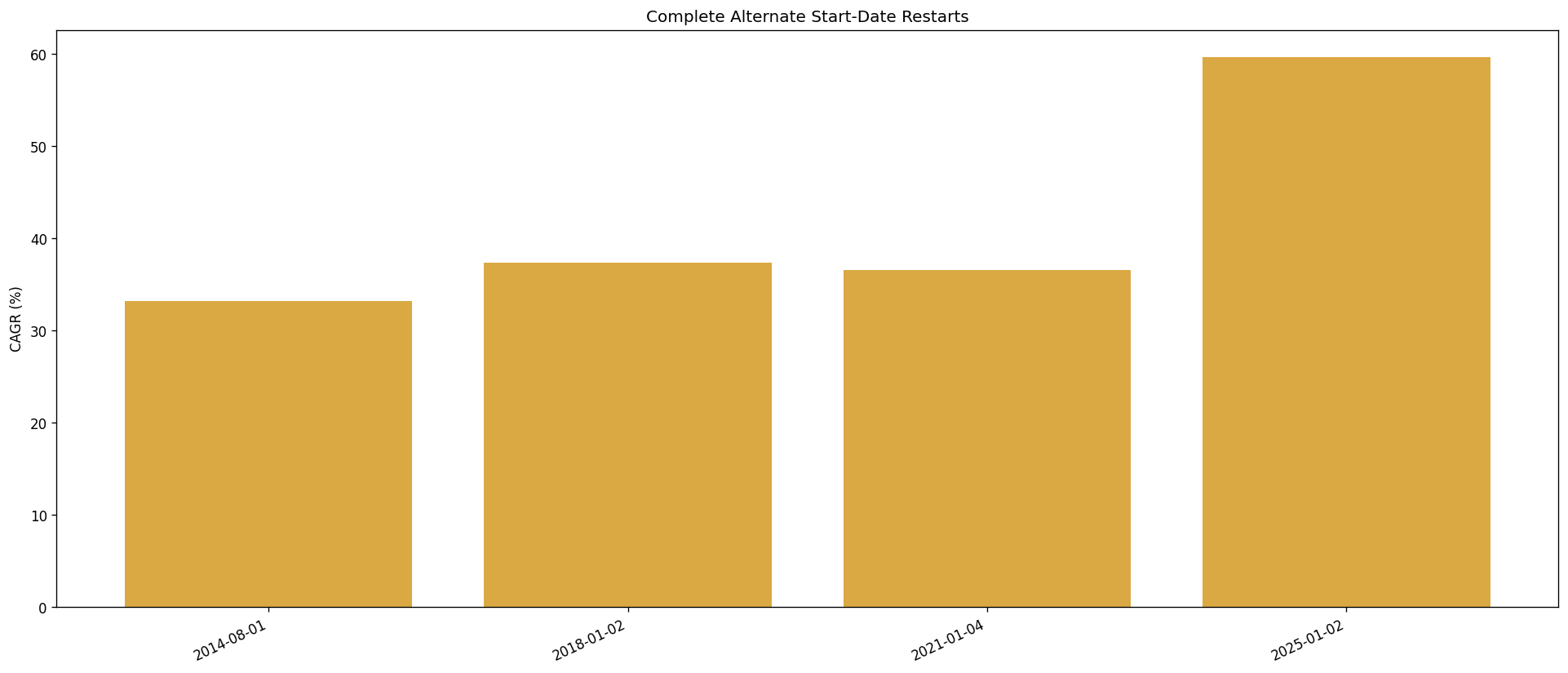
Alternate starting dates

Four complete alternate restarts were tested, and all were profitable. The minimum CAGR was 33.19%, while the worst maximum drawdown was -14.50%.

Dynamic alternate start date validation

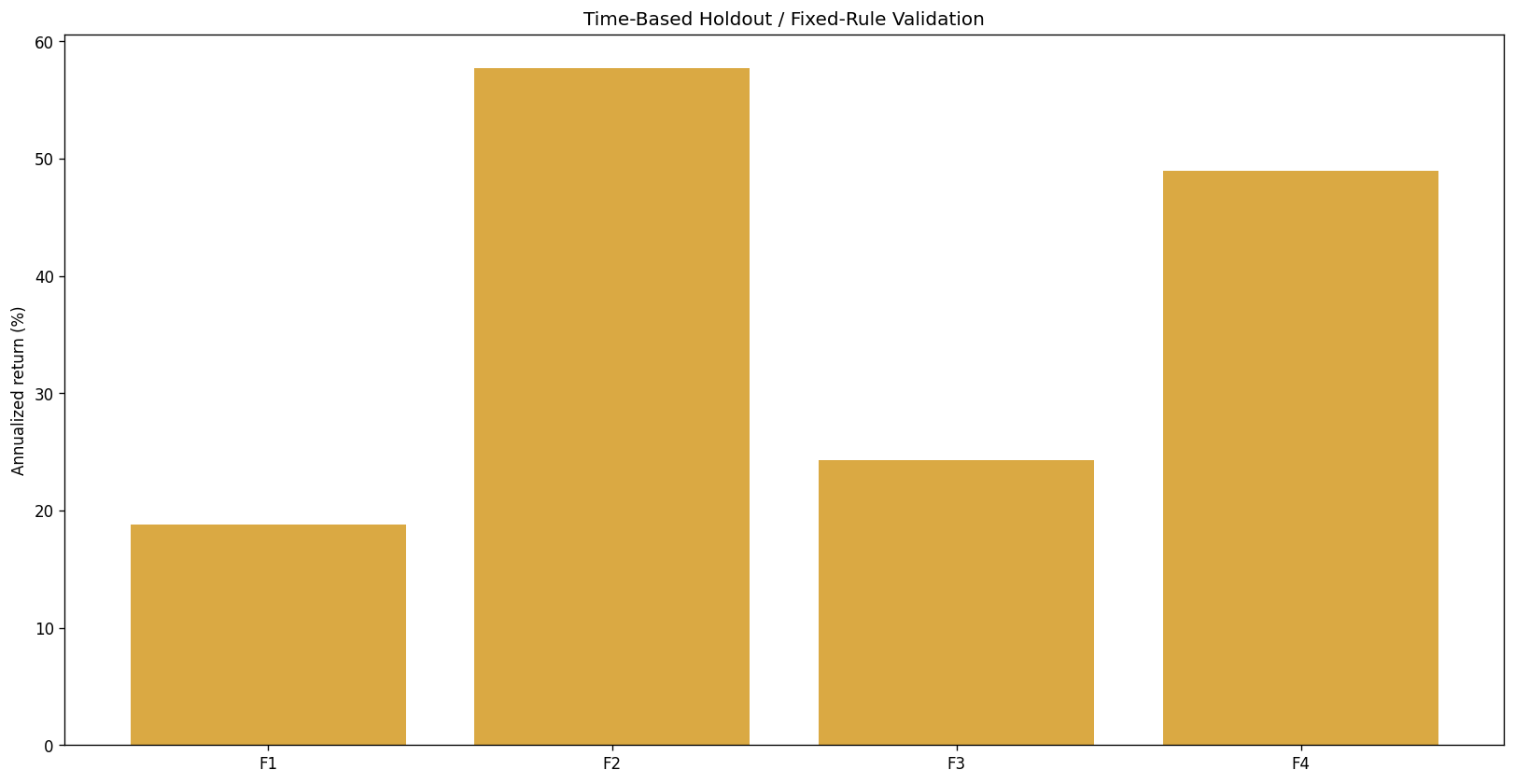
Walk-forward validation

All four out-of-sample windows were positive. The frozen final configuration produced out-of-sample CAGRs between 18.82% and 57.71%.

Dynamic walk-forward out-of-sample validation

Stress and Monte Carlo

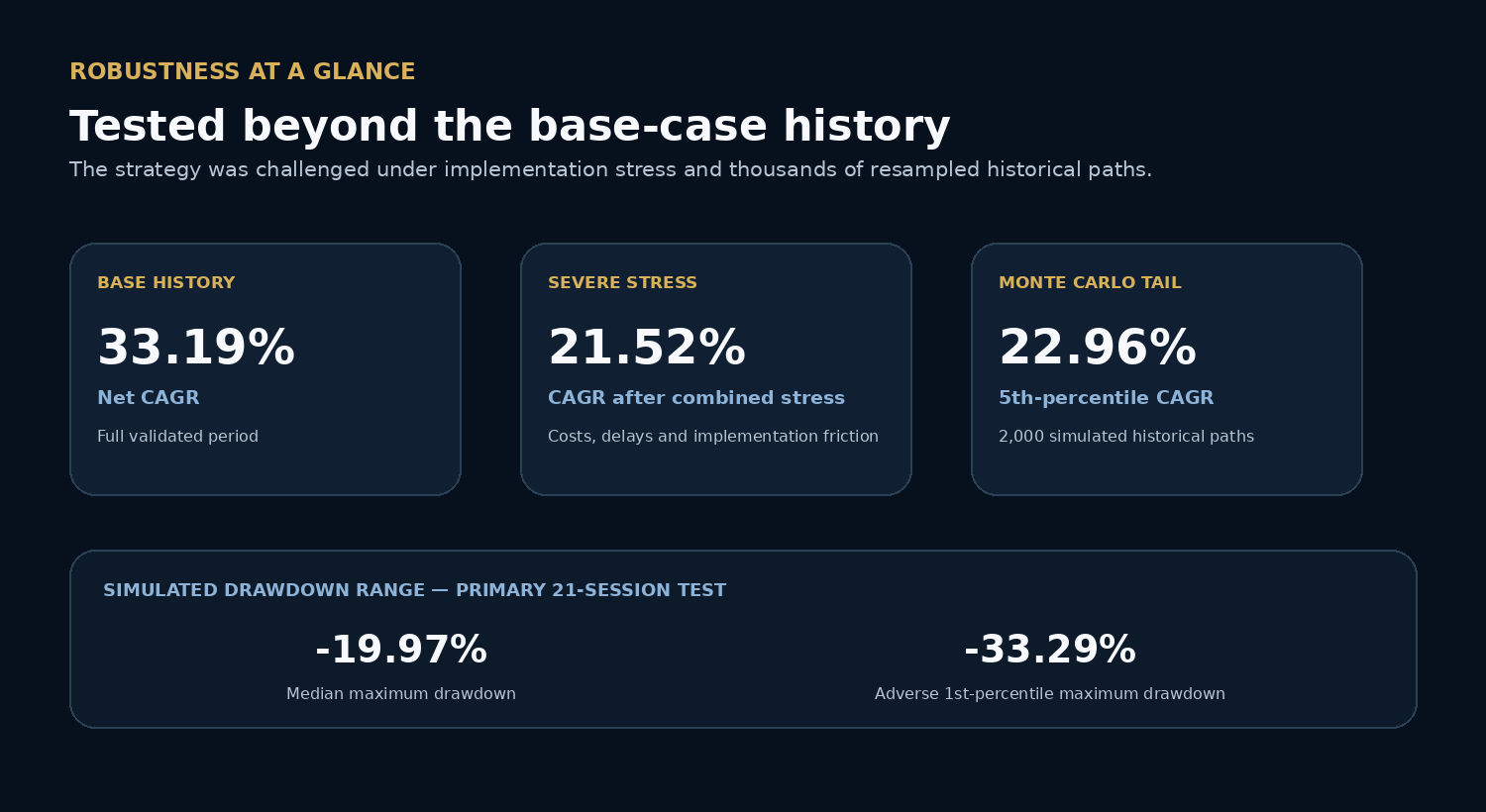
A severe combined implementation stress still produced a 21.52% CAGR. In the 2,000-path Monte Carlo study, the primary 21-session test produced a 22.96% CAGR at the 5th percentile, a -19.97% median maximum drawdown and a -33.29% adverse 1st-percentile maximum drawdown.

Dynamic robustness summary across historical, stress and Monte Carlo tests
Implementation

Private manual allocation alerts, not standard copy trading.

Subscribers receive a consolidated target only when the model requires a portfolio change. Instructions identify the intended instruments, target weights and implementation guidance after the relevant market data has been finalized.

Manual executionEligible broker requiredNo leverageNo short selling

Why manual?

Follower cash flows, lot sizes, distribution handling, partial fills and instrument availability can distort a multi-instrument target in generic copy-trading systems. Manual implementation preserves control and makes account-level differences explicit.

Exact instruments, weights and proprietary thresholds remain private to approved subscribers.

Investor fit

Designed for disciplined, long-horizon participation.

Potentially suitable for

  • Long-horizon investors seeking a systematic multi-asset process.
  • Investors who value explicit risk management and disciplined implementation.
  • Investors able to tolerate material drawdowns and follow periodic manual alerts.
  • Investors with an eligible brokerage account and fully funded capital.

Not designed for

  • Guaranteed capital or guaranteed returns.
  • Investors unable to tolerate losses or extended recovery periods.
  • Leverage, short selling or very short holding horizons.
  • Automated copying or public disclosure of proprietary implementation rules.